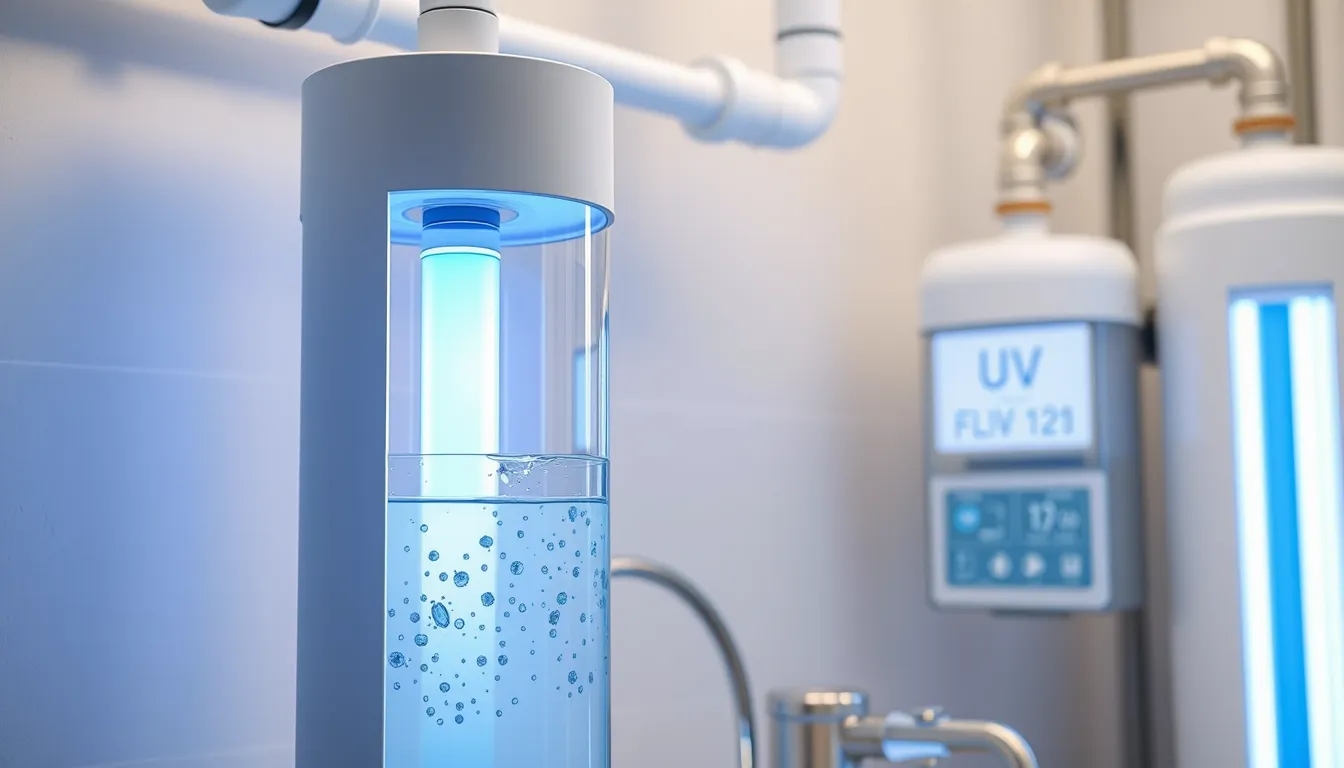
A UV disinfection system is the simplest way to keep living organisms out of your household water without adding a single chemical. Water flows past a germicidal lamp, the UV light scrambles the DNA of any bacteria, viruses, or protozoa passing through, and they can no longer reproduce or make you sick. It changes nothing you can taste or smell — no chlorine, no residue. This worksheet covers what a whole-house UV system actually does (and the important things it does not do), the one standard that separates a real disinfection system from a supplemental gadget, how it’s installed and maintained, honest cost ranges, and when to stop and call a licensed pro.
UV’s real strength is worth stating plainly: it inactivates the chlorine-resistant parasites Cryptosporidium and Giardia at low doses, which is exactly where chemical treatment struggles. According to the Centers for Disease Control and Prevention (CDC), UV treatment systems use ultraviolet light to disinfect water and reduce the number of germs in it. But effectiveness depends entirely on UV dose (intensity × exposure time) — and not every microbe falls at the same dose, which is where system selection matters.
The one spec that matters: NSF/ANSI 55 Class A vs. Class B
Before anything else, know which class of system you’re buying. The residential UV standard is NSF/ANSI 55, and it defines two very different products:
- Class A — 40 mJ/cm². Validated to disinfect water that may be microbiologically unsafe. This is the dose proven to inactivate bacteria, viruses, Cryptosporidium, and Giardia. If a lab test confirmed bacterial contamination in your water, only a Class A system is appropriate.
- Class B — 16 mJ/cm². A lesser dose intended only for supplemental bactericidal treatment of water that is already considered potable. A Class B unit cannot be relied on to make unsafe water safe — do not use one where contamination is confirmed.
Why the dose matters so much: UV is highly effective against bacteria and protozoa at low doses, but some viruses are UV-resistant. The CDC sets its virus dose guidance around adenovirus specifically because it is the most UV-resistant virus studied — it needs a much higher dose than Cryptosporidium does (CDC Yellow Book, Water Disinfection). A validated Class A (40 mJ/cm²) system is engineered to clear that higher bar. So the honest version of the “99.99%” claim you’ll see in marketing is: a properly sized, validated Class A system delivers high-level inactivation across bacteria, protozoa, and viruses — but only at the correct dose, in clear water, with a working lamp.
How UV Disinfection Works
Water flows through a stainless chamber that houses a UV lamp sealed inside a clear quartz sleeve. The lamp emits ultraviolet light in the UV-C band (200–280 nm); low-pressure mercury lamps — the type in nearly all home systems — concentrate their output at 254 nm, the germicidal peak. As microorganisms pass through, that UV-C light penetrates their cell walls and forms thymine dimers in the DNA and RNA — abnormal bonds that stop the genetic material from copying itself. The organism survives the trip but can no longer reproduce or cause infection.
Because it’s purely physical, UV has real advantages over chlorination: no chemical additives, no change to taste, odor, or pH, no disinfection byproducts, and instant treatment as the water passes through — no contact tank needed. It also handles the chlorine-resistant parasites chemical systems miss. Four things govern whether it actually works:
- UV dose — intensity multiplied by exposure time; the whole ballgame.
- Water clarity — turbidity and UV-absorbing compounds (iron, manganese, tannins) shield microbes from the light.
- Flow rate — push water through too fast and exposure time drops below the rated dose.
- Lamp condition — UV output fades long before the lamp stops glowing (more on this below).
The UV install & upkeep kit
What you need to put a system in and keep it running:
- NSF/ANSI 55 Class A UV system — sized to your home’s peak flow (gallons per minute) and rated for a 40 mJ/cm² dose if contamination is confirmed.
- 5-micron sediment pre-filter (plus housing) — installed upstream; manufacturers such as Viqua and Pentair specify filtration to 5 microns or finer so particles can’t shadow microbes or foul the sleeve.
- Spare UV lamp — one per year, matched to your exact model.
- Quartz sleeve (spare + O-rings) — the clear tube around the lamp; replace every 2–3 years or if scaled/cracked.
- Clean cotton or nitrile gloves — skin oils on a new lamp or sleeve create hot spots and cut UV transmission.
- Sleeve cleaner (CLR or a non-abrasive descaler) and a soft cloth.
- Shut-off / isolation valves and a bypass loop — so you can service the unit without cutting water to the house.
- GFCI-protected outlet — wired by a licensed electrician to local code.
- Solenoid / fail-safe shutoff valve (strongly recommended for confirmed-unsafe sources) — closes the water path if the lamp fails or UV intensity drops.
Installation, Step by Step
Installing a whole-house (point-of-entry) UV system is within reach for a confident DIYer, but the electrical hookup and any confirmed-contamination situation belong with a pro. Work in this order:
- Size the system. Match the unit to your household’s peak flow rate and water quality. Undersizing (too high a flow) drops exposure time below the rated dose.
- Pick the spot. Install as the last stage before water branches into the house — after the pressure tank and all filtration, but before the water heater. Keep it accessible, dry, and out of freezing temperatures.
- Set the pre-filter first. Plumb a 5-micron sediment filter upstream. This protects the sleeve and keeps particles from shielding microbes — essential on well water.
- Mount the chamber. Secure it vertically with clearance above for lamp changes; inlet at the bottom, outlet at the top to purge air pockets.
- Plumb it in. Connect to the main line with unions or flexible connectors, and add shut-off valves plus a bypass loop so you can service the unit without shutting off the whole house.
- Add a fail-safe (recommended). Where the source can be unsafe, fit a solenoid valve that closes if the lamp fails or intensity falls — UV gives no residual protection, so a dead lamp means untreated water downstream.
- Wire the controller. Mount it above the chamber (away from drips) and power it from a GFCI-protected outlet. Have a licensed electrician handle the connection.
- Set the sleeve and lamp. Slide the quartz sleeve in, seat the O-rings, then insert the lamp with clean gloves — never bare-handed.
- Pressurize and check for leaks. Open the water slowly, purge air, and inspect every fitting before powering the lamp.
- Energize and verify. Power the lamp, confirm the controller reads normal, and let it run.
- Test the water. After startup — and again a week later — send a sample for a microbial (coliform/E. coli) lab test to confirm the system is doing its job.
Ballpark cost: system + annual upkeep
UV has a modest running cost — a lamp and a few filters a year. Prices swing with system output, water quality, and whether a plumber does the install, so treat these as ranges, not quotes.
Whole-house UV system (unit only) ~$500–1,500 · Installed by a plumber ~$1,000–3,500 · Replacement lamp ~$50–200/yr · Quartz sleeve ~$60–80 every 2–3 yrs · Sediment cartridges ~$5–20 each, a few times a year · Electricity ~$40–60/yr · Ranges vary by market, output, and water quality
What UV does not do — read before you rely on it
UV gives no residual protection. It disinfects only inside the chamber — nothing downstream. If the lamp fails, a fuse blows, or the power drops, your water is untreated with no warning at the tap. On any source that can be unsafe, wire in a solenoid / fail-safe shutoff so the water stops when the UV does. UV removes no chemicals, heavy metals, nitrates, or bad taste/odor — it only kills microbes, so pair it with the right filtration for those. If a lab test confirms bacterial contamination, UV alone is not the whole answer: use a validated NSF/ANSI 55 Class A system, address the source (for a well, shock-chlorinate and fix whatever let contamination in), and re-test after. Leave the electrical to a licensed electrician on a GFCI circuit, and dispose of spent lamps as mercury-containing waste. When a job crosses into confirmed contamination, gas-free but live electrical work, or anything you’re unsure of — stop and call a licensed plumber or water-treatment pro.
Maintenance That Keeps the Dose Up
Replace the lamp every year
This is the maintenance task that matters most. Manufacturers rate residential UV lamps for about 9,000 hours — roughly one year of continuous use — and here’s the catch: the lamp keeps glowing long after its germicidal output has faded. By the end of that rated life, UV-C output drops to about 60% of a new lamp (roughly a 40% decline). It still looks lit, but it’s no longer delivering the dose your water needs. Replace it annually on the calendar, not when it goes dark. Handle the new lamp with clean gloves, and recycle the old one — it contains a small amount of mercury.
Clean the quartz sleeve
Scale and film on the sleeve block UV just as surely as a weak lamp. Clean it every 6–12 months (more often on hard water) with a non-abrasive descaler, and inspect for cracks — even a hairline flaw kills transmission. Replace the sleeve every 2–3 years. A water softener upstream slows scaling on hard water.
Stay ahead of the pre-filter
Change the 5-micron sediment cartridge every 3–6 months (sooner on sediment-heavy well water). A pressure drop at the tap is your cue it’s clogged. Clear water is non-negotiable — particles cast “shadows” that let microbes slip past unharmed.
Watch the sensor and re-test
If your controller has a UV-intensity sensor, check it regularly; a falling reading means an aging lamp, a fouled sleeve, or worsening water quality. Send a microbial water sample to a lab at least once a year — and after any heavy-rain event or change you notice in the water.
Limitations to Plan Around
- No residual disinfection. Protection ends at the chamber; contamination introduced downstream isn’t addressed.
- Needs clear water. Turbidity, iron, manganese, and tannins absorb UV and shield microbes — pre-treat them first.
- Power-dependent. No electricity, no disinfection. In outage-prone areas, plan for backup power or a fail-safe shutoff.
- Microbes only. UV does not remove chemical contaminants, heavy metals, or nitrates, and does nothing for taste or odor. See our guide to water filtration systems for pairing UV with the right filter stage.
- Ongoing upkeep. Skip the annual lamp or let the sleeve foul and the system quietly stops protecting you while still appearing to run.
Illustrative Scenario: UV on a Contaminated Well
Illustrative scenario — not a specific customer. This is a composite worked example to show how the pieces fit together on a typical rural well.
Say a rural household on a private well gets an annual test back showing coliform bacteria, with turbidity that spikes after heavy rain. A sound, code-minded fix would run in this order:
- Address the source first. Shock-chlorinate the well and correct whatever let contamination in (cap, casing, or surface drainage), then re-test to confirm the well itself is sound.
- Pre-treat for clarity. A 5-micron sediment filter handles the post-rain turbidity; a softener would be added if hardness is scaling the sleeve.
- Install a Class A system. Because contamination was confirmed, the unit is a validated NSF/ANSI 55 Class A (40 mJ/cm²), sized to the home’s peak flow, set after the pressure tank and filtration but before the water heater.
- Fit a fail-safe. A solenoid shutoff closes the line if the lamp fails, so a burned-out bulb can’t send untreated water into the house.
- Verify, then maintain. Re-test for coliform/E. coli after startup, then keep an annual lamp swap, periodic sleeve cleaning, and yearly lab tests on the calendar.
The takeaway isn’t “UV fixes wells.” It’s that UV is one layer in a system: fix the source, clear the water, disinfect with a validated Class A unit, fail safe, and re-test. A water softener earns its place here mainly by keeping scale off the quartz sleeve.
FAQs
To address common concerns and enhance engagement, here are some frequently asked questions about UV light disinfection:
-
Q: \u003cstrong\u003eCan UV light disinfection remove chemicals or heavy metals from water?\u003c/strong\u003e
A: No, UV light disinfection is specifically designed to neutralize microorganisms. For chemical contaminants or heavy metals, additional filtration methods such as activated carbon or reverse osmosis are necessary.
-
Q: \u003cstrong\u003eHow long does a UV lamp typically last?\u003c/strong\u003e
A: Most UV lamps are rated for about 9,000 hours of continuous use, which translates to approximately one year. It’s recommended to replace the lamp annually to ensure optimal disinfection.
-
Q: \u003cstrong\u003eIs UV light disinfection effective for well water?\u003c/strong\u003e
A: Yes, UV light disinfection is highly effective for well water. However, proper pre-filtration is crucial to ensure water clarity, as particulates can shield microorganisms from UV light.
-
Q: \u003cstrong\u003eDoes UV light disinfection affect the taste or odor of water?\u003c/strong\u003e
A: No, UV light disinfection does not alter the taste, odor, or chemistry of water. It solely targets microorganisms without adding or removing anything from the water.
-
Q: \u003cstrong\u003eHow do I know if my UV system is working properly?\u003c/strong\u003e
A: Many modern UV systems include sensors and alarms that monitor lamp function and UV intensity. Regular water testing can also confirm the system’s effectiveness.
-
Q: \u003cstrong\u003eCan UV light disinfection treat cloudy or turbid water?\u003c/strong\u003e
A: UV light disinfection is most effective in clear water. For cloudy or turbid water, pre-filtration is essential to remove particles that could shield microorganisms from UV light.
-
\u003cstrong\u003eQ: Is UV light disinfection safe for my family and pets?\u003c/strong\u003e
A: Yes, UV light disinfection is completely safe for humans and animals. The UV light is contained within the treatment chamber and does not enter your water supply.
-
\u003cstrong\u003eQ: How does UV light disinfection compare to chlorination?\u003c/strong\u003e
A: UV light disinfection offers several advantages over chlorination, including no chemical additives, no taste or odor changes, and effectiveness against chlorine-resistant pathogens.
-
\u003cstrong\u003eQ: Can UV light disinfection be used with rainwater collection systems?\u003c/strong\u003e
A: Absolutely. UV light disinfection is an excellent choice for treating collected rainwater, especially when combined with proper filtration.
-
\u003cstrong\u003eQ: What happens if there’s a power outage?\u003c/strong\u003e
A: During a power outage, the UV system will not function. Many systems include alarms to alert you when this occurs. Some advanced systems may have battery backups or automatic shut-off valves.
-
\u003cstrong\u003eQ: How often should I have my water tested after installing a UV system?\u003c/strong\u003e
A: It’s recommended to test your water annually, or more frequently if you notice any changes in water quality or after significant environmental events that could affect your water source.
-
\u003cstrong\u003eQ: Can UV light disinfection systems be used in conjunction with other water treatment methods?\u003c/strong\u003e
A: Yes, UV systems can be effectively combined with other treatments like water softeners, carbon filters, or reverse osmosis systems for comprehensive water purification.
-
\u003cstrong\u003eQ: Are there any water conditions that can reduce the effectiveness of UV disinfection?\u003c/strong\u003e
A: Yes, high levels of iron, manganese, or tannins can absorb UV light and reduce its effectiveness. Proper pre-treatment can address these issues.
-
\u003cstrong\u003eQ: How much electricity does a UV disinfection system use?\u003c/strong\u003e
A: UV systems are generally energy-efficient, typically using about as much electricity as a 60-watt light bulb when in operation.
-
\u003cstrong\u003eQ: Can I install a UV system myself, or do I need a professional?\u003c/strong\u003e
A: While some homeowners with plumbing experience may be able to install a system, professional installation is recommended to ensure proper setup and compliance with local codes.
Bottom Line
UV disinfection is a proven, chemical-free way to inactivate bacteria, protozoa, and viruses in whole-house water — and it’s uniquely good at the chlorine-resistant parasites Cryptosporidium and Giardia. To get that protection reliably: buy a validated NSF/ANSI 55 Class A system if contamination is confirmed, keep the water clear with a 5-micron pre-filter, swap the lamp every year before its output fades, and fit a fail-safe shutoff since UV leaves no residual. Treat UV as one layer in a system, not a cure-all — it kills microbes but removes no chemicals or metals. When the job crosses into confirmed contamination or live electrical work, bring in a licensed pro. If you’re also weighing broader treatment, our water filtration guide and notes on treating collected rainwater pair well with a UV stage.
Sources & verification
- NSF/ANSI 55 defines Class A UV systems (40 mJ/cm² dose, validated to disinfect water that may be microbiologically unsafe) and Class B (16 mJ/cm², supplemental treatment of already-potable water only) — NSF, Standards for Water Treatment Systems; corroborated at Fresh Water Systems, NSF Class A vs. Class B.
- UV inactivates bacteria, viruses, Giardia, and Cryptosporidium; efficacy depends on dose and exposure time, and virus dose guidance is set around adenovirus as the most UV-resistant virus — CDC Yellow Book (2026), Water Disinfection for Travelers.
- UV treatment systems use ultraviolet light to disinfect water / reduce germs — CDC, About Home Water Treatment Systems.
- Low-pressure mercury UV-C lamps emit primarily at 254 nm, the germicidal peak within the 200–280 nm UV-C band — Excelitas, Low-Pressure Mercury UVC Lamps.
- Residential UV lamps are rated for ~9,000 hours (about one year) of continuous output; annual replacement recommended; power draw ~60 W — Viqua VH410 specifications.
- UV lamp output declines to roughly 60% of a new lamp (about a 40% drop) by end of its rated life even while it still emits visible light — ESP Water Products, Viqua UV Lamps.
- A 5-micron (or finer) sediment pre-filter is specified upstream of a UV system to prevent particle shielding and sleeve fouling — Viqua 5-micron sediment pre-filter.
- Ballpark residential UV system and upkeep cost ranges (unit, installed price, replacement lamp/sleeve, electricity) — Mid-Atlantic Water, UV Water Treatment System Cost.
Last verified: Jul 2026