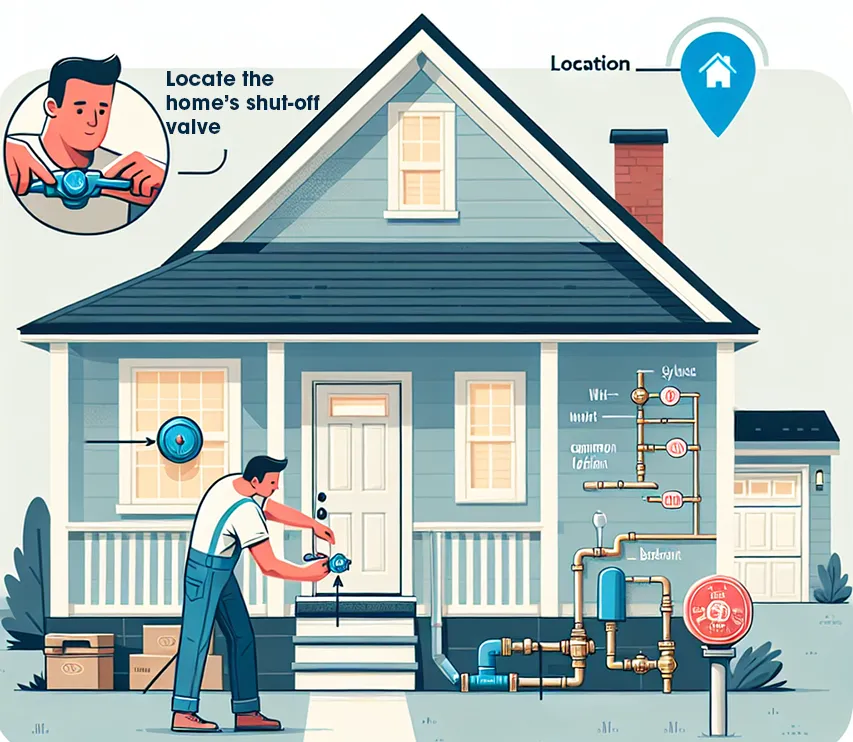
The main shutoff valve is one of the most critical components in your home’s plumbing system, yet many homeowners have no idea where it is or how to operate it. Water damage is one of the most common and costly problems a household can face: according to the Insurance Information Institute, about one in 67 insured homes files a water-damage or freezing claim every year, and water damage and freezing accounted for 22.6% of all homeowners insurance losses in 2023. When a pipe bursts, the difference between a quick cleanup and a five-figure repair often comes down to how fast you can reach the main valve and shut it off. This guide walks you through why the main shutoff matters, how to locate it, and how to operate and maintain it safely.
Start here: shut the water off fast
- Go to the main shutoff valve — know where it is before the emergency. It is usually where the water line enters the house: the basement, crawl space, garage, or an exterior wall, often near the water meter or water heater.
- Close the valve — for a round-wheel gate valve, turn the wheel clockwise until it stops (it takes several full turns). For a lever-handle ball valve, swing the lever a quarter turn so it sits perpendicular (90°) to the pipe.
- Bleed the pressure — open the lowest faucet in the house (and an outside spigot if you have one) to drain the lines and relieve trapped pressure. Water should slow to a stop, confirming the valve is holding.
- If the valve is seized or won’t hold, do not force a corroded gate valve — shut the water at the street/curb stop or call your water utility (see the safety note below).
- Then deal with the leak — with the water off, mop up, assess the damage, and call a plumber for the repair.
What you need
- A flashlight or headlamp — main valves hide in dark basements, crawl spaces, and closets
- A valve tag or label so everyone in the household can find it fast in an emergency
- Penetrating oil and an adjustable wrench or pliers for a stiff, sticky stem
- A curb key / meter key (long T-handle wrench) if you may need to reach the street or curb stop
- To know in advance where your street/curb shutoff is, as a backup to the indoor valve
What it costs to replace a failed main shutoff
If your main shutoff is corroded, seized, or leaking, a plumber can replace it or swap in a modern quarter-turn ball valve. The exact price depends on access, pipe material, and local labor rates, but this is generally a job of a few hundred dollars rather than a major project. One important distinction: the valve inside (or just outside) your home is yours to repair, but the curb or street shutoff belongs to the water utility — if that side has failed, the utility must shut and service it, not you or your plumber. Replacing a main shutoff usually means shutting the water at the street first, which is why it is typically a job for a licensed plumber rather than a DIY fix.
Plumber-replaced main shutoff / add a ball valve: typically a few hundred $ · Curb/street valve: utility responsibility · Water must be shut at the street to swap the main
Don’t force a seized valve — know your backup shutoff
An old gate valve that has not been operated in years can seize solid. If you crank hard on a stuck wheel, you can snap the stem or blow out the packing nut — turning a slow leak into uncontrolled flow you cannot stop at that valve. If the handle won’t budge with reasonable effort, stop. Know where your street or curb stop is as a backup so you can shut the water there (a curb key reaches most curb stops). If you break the main valve, or the failure is on the utility’s side of the meter, call your water utility or a licensed plumber immediately rather than trying to force or improvise a repair while water is flowing.
The Purpose and Importance of the Main Shutoff Valve
The main shutoff valve controls the flow of water into your home from the municipal supply or well system. In an emergency, such as a burst pipe or severe leak, shutting off the water at the main valve can prevent flooding and water damage, saving you thousands of dollars in repairs. It’s also essential to know how to operate the shutoff valve when conducting major plumbing repairs or during a home inspection. Understanding its role is crucial to protecting your home and ensuring the safety and efficiency of your plumbing system.
Locating the Main Shutoff Valve
Finding your main shutoff valve may seem daunting, but it’s often located in common areas designed for easy access. For most single-family homes, the valve is typically found in the basement, crawl space, or on an exterior wall near where the water line enters the house. If your home is on a slab foundation, the valve might be located in a utility room or near the water heater. In older homes, the valve could be near the water meter, which is often in the front yard or in a meter box. If you live in an apartment or a multi-family residence, the shutoff valve may be in a communal utility room, or each unit may have its own valve within the apartment. Knowing these general locations will help you quickly locate the valve in your home.
Identifying the Shutoff Valve
The shutoff valve can be mistaken for other plumbing components, especially if you are unfamiliar with your plumbing system. Typically, the valve is either a gate valve, which has a round handle that turns like a wheel, or a ball valve, which has a lever handle that moves 90 degrees to open or close. Look for a valve with a pipe leading into your home from the outside or directly from the ground. If you find a valve near your water meter or on the main water supply line, that’s likely the one you’re looking for. In some cases, there may be a tag or label indicating it as the main shutoff.
Safely Operating the Shutoff Valve
Once you’ve located the main shutoff valve, it’s essential to know how to operate it correctly. Work through the sequence below slowly and steadily — a sudden shutoff can send a pressure surge through the system, and forcing a stiff valve risks damaging it.
- Confirm the valve type: a round wheel means a gate valve; a straight lever means a ball valve. They close differently, so identify it before you start.
- Close a gate valve clockwise: turn the wheel clockwise (“righty-tighty”) until it stops. This usually takes several full turns. Do not wrench it hard against the stop.
- Close a ball valve a quarter turn: swing the lever 90 degrees until it sits perpendicular (crosswise) to the pipe. When the lever is in line with the pipe, the valve is open; crosswise, it’s closed.
- Turn slowly: close the valve gradually to avoid a pressure surge (water hammer) that could stress your plumbing.
- Relieve the remaining pressure: open a faucet or two inside the home — ideally the lowest one — to drain water still in the pipes and release trapped pressure. The flow should taper off to a stop, confirming the main is holding.
Maintaining the Shutoff Valve
Regular maintenance of your main shutoff valve is key to ensuring it functions properly when needed. Exercise the valve once or twice a year by turning it fully off and back on to prevent it from seizing up due to rust or mineral buildup. If you notice the valve is hard to turn, apply a penetrating oil to the stem and packing nut, give it time to soak, then try again with gentle, steady pressure. In some cases, if the valve is old or deteriorating, it might be wise to replace it entirely — a modern quarter-turn ball valve is far more reliable in an emergency than an aging gate valve. Keeping the valve area clean and free of debris also ensures you can access it quickly when needed.
When to Use the Main Shutoff Valve
There are several scenarios when it’s necessary to turn off the main shutoff valve:
- Burst Pipes: In the event of a burst pipe, shutting off the water immediately can prevent extensive flooding and water damage.
- Major Plumbing Repairs: Before undertaking any significant plumbing repairs, turning off the main valve ensures no water flow can disrupt your work or cause additional damage.
- Plumbing Emergencies: Situations like major leaks, overflowing toilets, or malfunctioning water heaters often require immediate shutdown of the water supply.
- Extended Vacations: If you’re leaving your home for an extended period, shutting off the main valve can prevent any unexpected leaks or floods while you’re away.
Understanding when and how to use your main shutoff valve is crucial for maintaining the safety and integrity of your home.
FAQs
Q: What should I do if I can’t find my main shutoff valve?
A: If you’re unable to locate your main shutoff valve, check common locations such as the basement, utility room, or near the water meter. Many water utilities will also send a representative to help you find your property’s shutoff. If all else fails, contact a professional plumber who can help you identify and locate the valve.
Q: How often should I maintain my main shutoff valve?
A: It’s recommended to exercise the valve by turning it off and on at least once or twice a year. This practice prevents the valve from seizing and ensures it remains operational in an emergency.
Q: Can I replace a faulty main shutoff valve myself?
A: Replacing a main shutoff valve can be a complex task that requires shutting off the water at the street level. If you’re not experienced with plumbing work, it’s best to hire a professional to ensure the job is done safely and correctly.
Q: Is it normal for the shutoff valve to be hard to turn?
A: Over time, valves can become stiff due to rust or mineral buildup. Applying a penetrating oil to the valve’s stem and packing nut may help. However, if the valve remains difficult to operate, do not force it — a snapped stem causes uncontrolled flow. It likely needs replacement.
Q: What should I do if I accidentally break the shutoff valve?
A: If the valve breaks while you’re attempting to operate it, shut the water at the street or curb stop if you can, then immediately contact your water utility or a professional plumber. Do not attempt to fix it yourself while water is flowing, as this could lead to further damage.
Conclusion
Knowing how to locate and operate your home’s main shutoff valve is a fundamental skill every homeowner should have. By understanding the importance of this valve, knowing where to find it, and maintaining it regularly, you can protect your home from water damage and ensure that any plumbing emergencies are handled efficiently. Remember, in a crisis, seconds count, and being prepared can save you time, money, and stress.
Take five minutes today: find your main shutoff, tag it, and make sure everyone in your household knows where it is and how to turn it off.
Sources & verification
- Water damage and freezing claim frequency (about 1 in 67 insured homes per year) and share of homeowners losses (22.6% in 2023) — Insurance Information Institute (Triple-I).
- Household leaks waste roughly 9,400 gallons per home each year — U.S. EPA WaterSense, Statistics and Facts.
- Small household leaks add up to nearly 1 trillion gallons wasted nationwide annually — U.S. EPA WaterSense, Fix a Leak Week.
- How to find and operate your home’s main water shutoff (gate valve turns clockwise; ball valve closes at 90° to the pipe; know the street/curb shutoff) — San Francisco Public Utilities Commission.
Last verified: Jul 2026