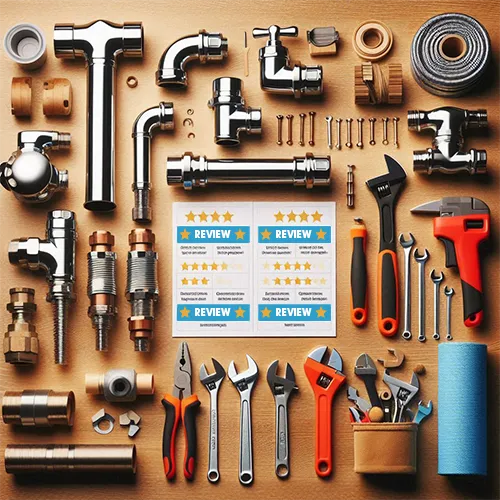
Knowing a handful of plumbing terms makes you faster in an emergency, sharper on a repair, and harder to overcharge when you call a pro. This glossary covers 10 words every homeowner runs into — each with a plain definition, why it matters, and a real-world example — plus a few that carry genuine safety weight. Learn these and you can describe a problem accurately, shut the right thing off, and know when a job is DIY versus a call to a licensed plumber.
The 10 terms at a glance
- P-Trap — the U-bend that blocks sewer gas
- Flange — seals a toilet to the floor drain
- Shut-Off Valve — stops water to one fixture
- Backflow — reverse flow that can contaminate the supply
- Pipe Coupling — joins two pipes
- Vent Stack — equalizes drain pressure, vents gas
- Sump Pump — pumps water out of a basin
- Water Hammer — banging pipes from a sudden valve close
- Aerator — the faucet-tip screen that adds air
- T&P Valve — the water heater’s safety relief valve
P-Trap
A P-trap is the U-shaped pipe under a sink, tub, or shower that holds a small plug of water — the trap seal — to keep sewer gases from rising into the room.
That water seal is what protects your indoor air quality; if a trap dries out or siphons empty, you’ll smell the drain. Plumbing codes require the seal to be 2 to 4 inches deep, and they specifically prohibit S-traps — the older S-shaped design self-siphons dry as water rushes past, breaking the seal. If a fixture keeps smelling despite a trap, a hidden S-trap or a venting problem is a common cause.
Drop an earring down the sink? The P-trap is your first stop — put a bucket under it, unscrew the two slip nuts, and the item is usually sitting in the bend.
Flange
A (toilet) flange is the fitting that anchors a toilet to the floor drainpipe and provides the mating surface for the wax ring that seals the connection.
The flange keeps the toilet from rocking and keeps water and sewer gas from escaping around the base. A cracked or corroded flange — or one set below the finished floor — is a leading cause of a toilet that leaks at the base or wobbles.
Water pooling around the base of the toilet, or a toilet that rocks, often points to a failed flange or wax ring. Repairing the flange (or adding a flange spacer) resolves it.
Shut-Off Valve
A shut-off valve controls water to one part of the system — a sink, toilet, or appliance — so you can stop the flow there without cutting off the whole house.
Knowing where these are (and where the main shut-off valve is) is the single most useful thing you can know in a leak — it’s the difference between a mopped floor and a flooded room. Exercise seldom-used valves once a year so they don’t seize.
If a toilet is overflowing, turn the oval or football-shaped stop valve at the base clockwise to shut it off before you do anything else.
Backflow
Backflow is water flowing the wrong way through the plumbing — back toward the clean supply — which can pull contaminants into your drinking water through a cross-connection.
It happens when pressure drops or reverses (a water-main break, heavy demand, or a pump). The defenses are an air gap (a physical space between an outlet and any standing water) and testable backflow-prevention assemblies on higher-risk connections like irrigation and boilers.
A hose left submerged in a bucket of soapy water, or a garden hose in a pool, is a classic cross-connection — a hose-bib vacuum breaker on the spigot prevents that dirty water from being siphoned back inside.
Pipe Coupling
A pipe coupling is a short fitting that joins two pipes of the same size end to end. It comes in copper, PVC, PEX, and other materials to match the pipe.
Couplings extend a run or splice in a repair, giving a secure, leak-free connection. A slip (repair) coupling has no internal stop, so it can slide fully onto one pipe and then back to bridge a cut section — handy for fixing a burst line without cutting out a long stretch.
Extending a water line for a new fixture? A coupling of the right material and size joins the new pipe to the existing one.
Vent Stack
A vent stack is the vertical pipe that runs up through the roof, letting air into the drain system and sewer gases out.
Vents do two jobs: they let sewer gas escape above the roof, and they equalize air pressure so draining water doesn’t siphon the trap seals dry. A blocked vent is a frequent cause of slow, gurgling drains and drain odors.
Drains across the house that gurgle or drain slowly — especially with a smell — often mean a vent blocked by a nest, leaves, or ice. Clearing it from the roof restores normal drainage.
Sump Pump
A sump pump sits in a pit (the sump basin) in a basement or crawl space and pumps out groundwater before it can flood the floor.
They’re essential where the water table is high or the basement takes on water. Because the one time you need it is during a storm — often a power outage — a tested pump plus a battery backup is what actually prevents a flooded basement and the mold that follows.
After heavy rain, a working sump pump kicks on automatically as the pit fills and discharges the water outside, away from the foundation.
Water Hammer
Water hammer is the loud bang in the pipes when a fast-closing valve — a washing-machine solenoid, a single-lever faucet — slams the moving water to a stop, sending a pressure wave through the line.
Left alone, that repeated shock can loosen joints and fittings over time. The modern fix is a sealed, air-charged water-hammer arrestor at the offending fixture; keeping house pressure in the normal range (a pressure-reducing valve above 80 psi) helps too.
A bang every time the washing machine or dishwasher shuts its fill valve is textbook water hammer — an arrestor on those hookups usually silences it.
Aerator
An aerator is the small screened fitting on the tip of a faucet that mixes air into the stream, giving a steady, splash-free flow and straining out grit.
A standard aerator’s main jobs are reducing splashing and adding air — it doesn’t automatically save water. What saves water is a flow-restricting or WaterSense-labeled aerator, which caps a bathroom faucet at 1.5 gallons per minute or less versus the 2.2 gpm of an unrestricted one — about a 30% cut with no loss of usable pressure. Aerators also clog with mineral scale, so they’re the first thing to check on a single slow faucet.
One faucet spitting or running weak while the rest are fine? Unscrew the aerator, rinse the screen (soak it in vinegar for scale), and reinstall — flow usually returns.
T&P Valve (Temperature & Pressure Relief Valve)
A T&P valve is the safety valve on a water heater that opens to release water if the temperature or pressure inside the tank climbs too high — the device that keeps an overheating tank from rupturing.
It’s the tank’s last line of defense, and codes require it plus a discharge pipe routed down to near the floor. The one rule that matters: never cap, plug, or block a T&P valve. If it weeps or drips, that’s a signal — excess pressure (often thermal expansion on a closed system) or a failing valve — and the cause should be found, not the valve silenced.
Water dripping from the T&P discharge pipe means the valve is doing its job in response to a problem — check for high pressure or a stuck valve rather than plugging it.
The three that are about safety, not just vocabulary
Most of these terms just help you communicate. Three protect you: the shut-off valve (know your fixture stops and your main before you need them), backflow prevention (it’s your drinking water on the line), and the T&P valve (never blocked — it prevents a water-heater rupture). Leave gas connections and anything you’re unsure of to a licensed plumber.
Tips for Homeowners
- Keep a glossary handy: a quick reference to plumbing terms is genuinely useful mid-project or when you’re on the phone with a plumber.
- Label your shut-off valves: tag the main and the fixture stops so anyone in the house can kill the water fast in an emergency.
- Do the easy maintenance: rinse aerators, keep a trap from drying out in a seldom-used sink (run it monthly), and test the sump pump and T&P valve so they work when it counts.
FAQs
-
Why Is It Good to Know Plumbing Terms?
Understanding plumbing terms is essential for homeowners as it enhances communication with plumbing professionals and helps in diagnosing issues. Familiarity with these plumbing terms can also empower you to handle minor repairs and maintenance tasks confidently.
-
What Are the Most Important Plumbing Terms to Know?
Some of the most critical plumbing terms every homeowner should know include:
Water Main: The primary pipe supplying water to your home.
Shut-off Valve: A valve that stops the flow of water to specific fixtures or the entire house.
P-Trap: A U-shaped pipe under sinks that prevents sewer gases from entering the home.
Flapper: A valve in toilets that controls water flow from the tank to the bowl.
Aerator: A device attached to faucets that reduces water splashing and conserves water. -
What Is a P-Trap and Why Is It Important?
A P-trap is a crucial plumbing component that traps a small amount of water to create a seal against sewer gases. It is typically found under sinks and is vital for maintaining indoor air quality by preventing odors from escaping through the drain.
-
How Do I Locate My Main Water Shut-off Valve?
The main water shut-off valve is usually located near where the water line enters your home, often in the basement, crawl space, or near the water heater. Knowing its location allows you to quickly shut off the water supply in emergencies.
-
What Is the Difference Between PEX and PVC?
PEX (cross-linked polyethylene) is a flexible plastic piping used for water supply lines, known for its ease of installation and resistance to scale and chlorine. PVC (polyvinyl chloride) is a rigid plastic commonly used for drainage and waste systems. Each has its specific applications and advantages.
-
What Is Backflow and How Can It Be Prevented?
Backflow is the unwanted reversal of water flow in a plumbing system, which can lead to contamination of the potable water supply. It can be prevented by installing backflow preventers, which are devices that ensure water flows in only one direction.
-
How Often Should I Inspect My Plumbing System?
Regular inspections of your plumbing system are recommended at least once a year. This can help identify potential issues such as leaks, corrosion, and clogs before they become significant problems.
-
What Is a Sump Pump and When Is It Needed?
A sump pump is a device installed in basements to prevent flooding by removing excess water that accumulates in a sump pit. It is particularly important in areas prone to heavy rainfall or high water tables.
-
What Are Common Signs of Plumbing Issues?
Common signs of plumbing issues include:
Unexplained increases in water bills, Slow drains or frequent clogs, Water stains on walls or ceilings, Unpleasant odors coming from drains, Low water pressure
Conclusion
Learn these plumbing terms and you’ll manage your home’s system with more confidence — describing problems accurately, making informed calls on repairs and upgrades, and knowing which jobs you can take on yourself and which belong to a licensed pro. Understanding the words is the first step to understanding the system behind them.
Sources & verification
- Trap seal depth (2–4 in) and the prohibition on self-siphoning S-traps — International Plumbing Code (IPC) §1002, via UpCodes — Traps.
- Water-heater temperature & pressure relief valve requirements (relief valve required; discharge routed; not to be obstructed) — IPC §504, via UpCodes — Relief valves.
- WaterSense bathroom faucets use ≤1.5 gpm vs the 2.2 gpm standard (about 30% less) — U.S. EPA WaterSense — Bathroom Faucets.
- Plumbing terminology reference — IAPMO / Safe Plumbing — Glossary.
Last verified: Jul 2026